Friday, February 8, 2019

Meeting Moses

Wednesday, February 6. 2019

This morning I pushed myself to get up and ready for the day a bit faster than usual because I wanted to be there when Mary Lou left for her first day of teaching at the Albino Peacemakers. She has spent a lot of time preparing for this, and will focus today on individual assessments of each woman’s English proficiency. For some that will be fairly functional, but others who have not had an opportunity for much education will be beginners. Mary Lou was smartly dressed in blue as she resolutely set off to walk the 3.5 kms to the workshop.

Mary Lou all dressed in blue.

After seeing Mary Lou off, John and I stayed on the garden terrace, where it is usually cooler with more breeze than there is on our unshaded east-facing terrace. We were anticipating the arrival of our former student, Moses Pulei, who was coming at 11:00. It is always a joy to see Moses and catch up with all that he is doing. After several years working for WorldVision, he branched out on his own and has certainly become one of the most inventive entrepreneurs I’ve ever met. Several years ago, he began a program growing chia in Uganda, using former child soldiers as workers. Now that the price of chia has decreased, he has entered an agreement with a major American company to supply chia for chicken and hog feed. Feeding chia to chickens and pigs will increase the Omega-3 in eggs by 20% and add Omega-3 to pork. Can you imagine healthy pork?

Soon after Moses arrived, we three went off to the Blue Heron, where we could relax and talk more privately. There was a lot to share about mutual friends and families. Moses had not heard that Doris Liebert had passed away, and we were amused by the stories he told us about another former student from Kenya. We ordered lunch and enjoyed continuing talking until it seemed obvious that Moses needed to leave and continue his day. I wonder if he knows how wonderful it is for us to see him as he has become. If his daughter would chose to come to Whitworth, we might see even more of him and his wife, Brittaney.

Moses and John at the Blue Heron


My incredible Niçoise salad


John left with Moses just before 2:00, but I stayed at the Blue Heron for another hour. Terry Morton had come there for her lunch, so I went to sit in the shade with her and read for a while. Of course, we spoke some about Mary Lou’s morning, which sounded very successful as well as very long to me. Terry and Mar Lou had walked together as far at the Impala roundabout, where Mary Lou turned to walk via Kjenge back to Kundayo, and Terry continued on Old Moshi and Haile Selassie to the Blue Heron. Both were long, hot walks.

I, being far more wimpy, called Ray at 3:30 to come and get me at Blue Heron. I was glad to see him again after last night and thank him once more for the wonderful dinner and visit we had with his family last night. Then, when I was back at Kundayo again, I asked Mary Lou to tell me about her morning and got a complete report of her activities with the albino women. She will do a spectacular job for them!

Later, when we having dinner and wondering what we would do tomorrow, the phone rang. It was Terry Morton calling to let us know that a tour group would be stopping by the workshop tomorrow at 2:00 p.m. We want to go so that we can meet Sister Margaret, the director of the organization, and hear what she or Terry tells people who visit the workshop. There is always something new to learn.

Wednesday, February 6, 2019

Family Dinner

Monday, February 4, 2019


Today was busier than I had wanted it to be. Right after breakfast, Mary Lou wanted to go into town to return our skirts to FiFi’s for some slight alterations and to buy some supplies for her classes with the Albino Peacemaker women. Even though I wasn’t all that eager to go, I agreed because I did need to have my first skirt lengthened somehow. So, as always, we called Ray to drive us to FiFi’s. The young woman from Afrileo Collections was not there, so Mary Lou took off to explore stationery stores, while I stayed behind to wait and enjoy a cup of coffee. (John went somewhere, too, but I forget where.) Anyway, Leonica finally came in, and I explained what we needed done to our skirts and left them with her. Mary Lou returned without finding any index cards, so we left FiFi’s and walked toward Kitamu, my favorite cafe.

I had remembered a little stationery store near Kitamu which I thought might have index cards, but of course they didn’t. However, as we were looking at absolutely everything that they did have, Mary Lou found a pack of heavy stock card-like paper which she thought she could cut to size. John decided to walk back to Kundayo, but Mary Lou and I went on to Kitamu, where we found Terry Morton. While Terry ate her lunch, we had cold drinks before calling Ray to bring us back to Kundayo. I had some leftover pizza for my lunch and then took a nap.

Ray had previously invited us to his mother’s house for dinner this evening and said he would arrive between 6:30 and 7:00 to pick us up. So, soon after 7:00, he appeared, and off we drove down some narrow, unmarked dirt roads on the other side of our big highway. Except for downtown and some major highways, none of the roads or street here are marked, and I have never figured out how anyone can find any other house or small shop. Neighborhoods are like crazy mazes of bigger and littler dusty streets, twisting and turning without any apparent reason. But, of course, Ray knew where to go.

The family gathering was much smaller than it would have been on a weekend day, but Ray, Honorina, and Anita, Ray’s mother, aunt, cousin, and brother, George, were all there, as well as George’s little son. A couple of neighbors wandered in and out to greet us, too. Ray’s mother is a lovely woman, and I am always struck with how much Ray looks like her. His aunt and cousin are both teachers, so we had a good discussion about the state of the government schools, which have 60 to 70 students in each class with almost no textbooks or other materials. George had laryngitis, so we couldn’t visit much with him, but I think his electronic business is doing well. The women had prepared a wonderful buffet of rice, beans, fried chicken, chapatis, greens, salad, and watermelon. It was all very delicious, and I was touched by how much time and expenditure it represented.

Ray's cousin and mother
The buffet prepared in our honor.
My plate. The chapati was delicious!

The children in the hall.

Mary Lou mentioned that she had a ktenge, so Ray’s mother got out a couple of her dresses to show us what tailors can create with a length of cloth. Then, she brought out a full 6-yard piece of fabric, wrapped it around us, and said it was a gift. That was incredibly generous, and I had to wonder if Mary Lou realized how very special the whole evening was. She would never have been included in such a family dinner here without riding on the coattails of our longtime relationship with the Mtui family. They are a true treasure, and we are always honored to be invited to their mother’s home. (Unfortunately many of the photos we took did not turn out well because of a faulty camera setting.)

Wrapped up.

Mama's dress.

Finally, around 9:00, we said our good-byes, and Ray brought us back to Kundayo. I was exhausted and soon tried to go to sleep. However, I had a tumultuous night during which I awoke at least 5 times and had a vivid dream in which I was trying to hide from evil soldiers by slipping behind some white drapes. Fortunately, I woke John up, and he saved me from leaping out of bed and diving under the bedside table’s white tablecloth.

People Everywhere

Sunday, February 3, 2019


Sunday always means going to church, so we were up, dressed, and ready to go by 10:00. But instead of Ray, some man named Dennis showed up to drive us. He said Ray was in the 9:30 service, which I took to mean that little Anitha had won the battle over whether to go to the 6:30 service or a later one. Anitha complains when she has to get up early because Ray wants to attend church before driving us. I don’t blame her at all!

Anyway, Dennis wanted to discuss African politics with John all the way to ACC, and he knew an impressive amount of who was in power where during the past 30 or so years. He even prompted John a couple of times. It’s too easy to assume that people of humble means will not know very much outside their daily lives or national politics, but many people here put the average American to shame with the scope of their knowledge of not only Africa but also Europe and America. Mama Kundayo loves to talk about the current events she sees on MSNBC, Al Jazeera, and BBC.

There were lots of wazungu visitors at church: there was a group of 20 or so aged Lutherans from the Pacific Northwest and another smaller group of American engineers who are planning some sort of sustainable agriculture project somewhere. A couple Norwegians and others introduced themselves as well at the appropriate time. A large man who serves as a paster in Lacey, Washington gave the sermon, which, while good, probably went over the heads of many of the congregants because of his heavy use of American English cliches and cultural references. I was most disturbed that there were NO flowers this Sunday. How could that have happened?

After the service, during the tea, coffee and mingling time, I went over and re-introduced myself to Jana Hardy Kinsey, who also comes from Spokane and is now married to Irwin Kinsey’s son. They have two very cute little girls, Lydia and Leila, and live somewhere outside of Arusha. Jana was part of a legal team which worked for Masai women’s rights when we first were here in 2012 and two of the Whitworth students did internships with her and her partner. She someone I have admired since I first met her.

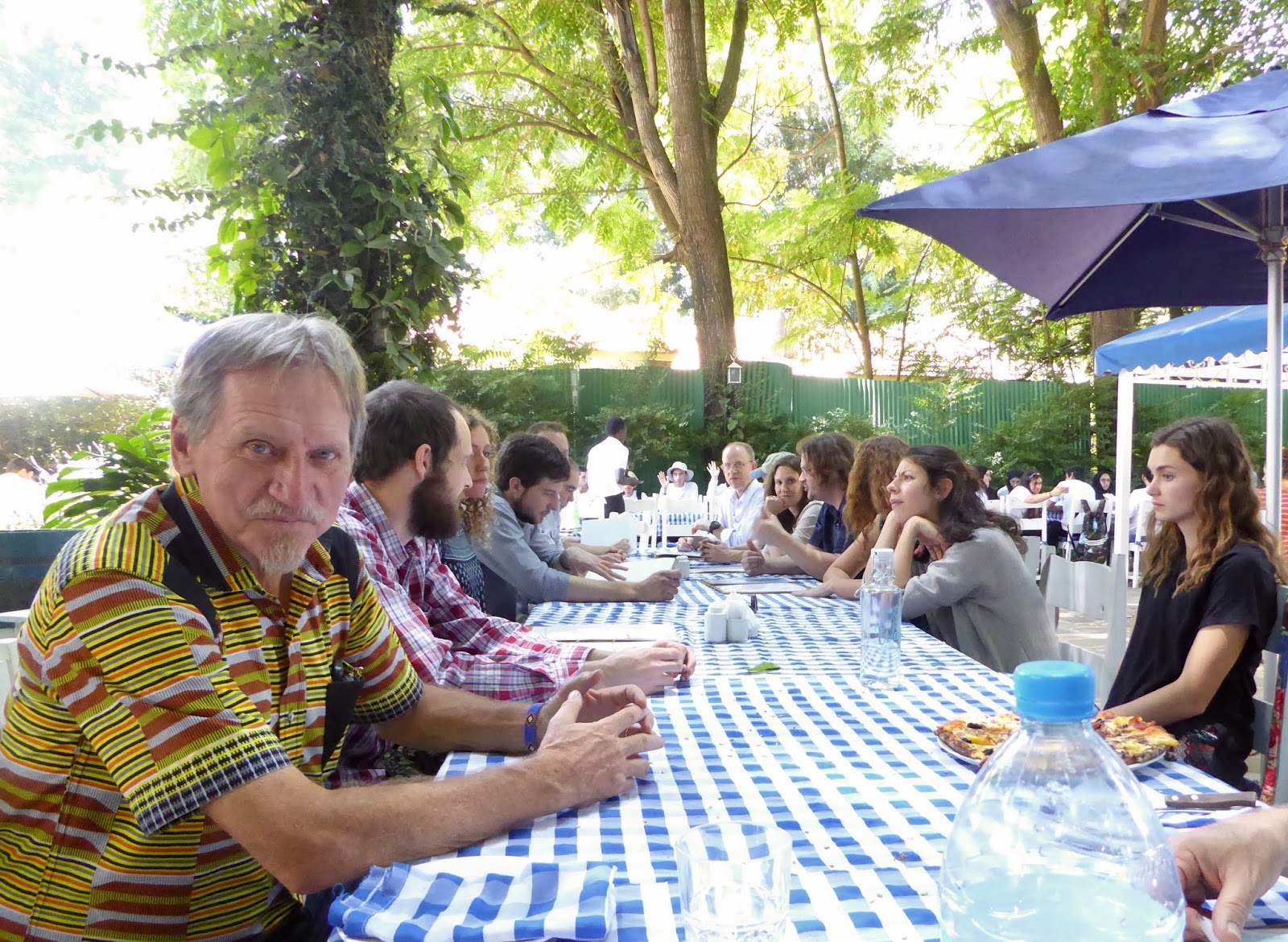
Eventually, John, Mary Lou and I got a taxi and went to George’s for lunch. We had barely gotten settled, when Margaret (I forget her last name), an 80+ year-old female veterinarian way off in Karatu arrived and asked if she could join us. I was very happy because I find Margaret to be a fascinating person. However, we had barely begun to add another chair to our table, when Irwin Kinsey showed up with a young couple and asked if they could join us, too. Of course, we agreed and then were astonished  when Irwin and the waiters set up a long line of tables for an additional 15 people. He was bringing the group of engineers who had been at church plus a couple of young people who work on his agricultural projects (https://www.echonet.org/staff/global/east-africa/). The dynamics of our nice, quiet lunch were changed, but because the leader of the engineers, Rex Barber, came to sit near us, we had an interesting conversation about aquaponics, etc. Unfortunately, I didn’t get to speak much at all with Margaret, who had to leave early in order to getting some shopping done before she headed back out to her station.

Irwin Kinsey and his group.

John ordered George’s Sunday Special, grilled pork, while I got a pizza and Mary Lou a salad. We had barely finished our meal, when suddenly, Ray showed up with Priskilla and Anita. Priskilla had come into town to get her new glasses and wanted to tell me thank you before she returned to school. So, we had to leave the others in the lunch group to spend a bit of time with Ray and the girls and take photos. For some reason Ray insisted on holding our take-take-away cartons from lunch, and so he looks like a pizza delivery man in most of the pictures. Eventually, we all piled into Ray’s taxi and came back to Kundayo.

Grilling at George's
John's pork plate with 3 hunks of grilled pork and 2 baked potatoes, plus a large salad.
John and I with Anita, Priskilla, and Ray

We read and rested until 7:00 p.m. here when we tried to call Peri at 8:00 a.m. her time. The internet was not functioning well, so we were frustrated by connecting and then disconnecting after a few seconds. After about six times like this, I suggested we wait to try in another half hour. Then, when we connected everything went just fine, and we learned about Peri’s visit to the dentist and her new toothbrush.

Tuesday, February 5, 2019

Being a Mzungu

Saturday, February 2, 2019

This was a day focused on pleasure. It was Sharon Mkisi’s birthday, so a group of us was going to drive out to Usa River, about 19 kms east, to Rivertrees, a high-end resort, for lunch. Since Kundayo is only the highway going east, Sharon planned on stopping to pick up Mary Lou and me. That was to happen at 12:10, but as one might expect did not occur until 12:35. While we waited, I amused myself by playing with a goat tethered to a pole. The young piki-piki drivers found that amusing.

My new friend.

However, all good spirits left when Sharon pulled up and slightly side-the swiped one of the piki-pikis which was partially out on the road itself. Everyone got very animated though no one was hurt, and  the helmet which had rolled under the front wheel was undamaged. There was a dent in the fuel tank, but nothing to prevent normal operation. I told the driver that he should not have had his bike out on the road, and Sharon ordered us to get in the car quickly. Once we did so, she drove away. I was uncomfortable with leaving so abruptly, but I know that here small incidents like this can quickly escalate into ugly mobs. Also, when wazungu are involved, threats and extortion are not uncommon. Still, the incident left me feeling unsettled— especially since we pass the piki-pikis each time we leave or enter Kundayo Road.

It was difficult for me to regain a celebratory spirit even though the drive out to Usa River was interesting and the Rivertrees resort proved to be a lovely old colonial thatched lodge type of place. I was told that rooms there cost $300 and above overnight and that its guests have included the Clintons and other notables. I didn’t see anything to merit that high charge, but I did spy wazungu wandering about the beautifully treed grounds in perfectly matched safari outfits, which were likely purchased at specialty companies. There were also a lot of vervet monkeys swinging in the trees and jumping and tussling on the lawn. The bright blue balls of the males flashed like special party lights.

Rivertrees' main dining area.

There were only 7 of us for lunch, and I realized that this was the first total wazungu affair I have been to this year—or maybe for several years. In fact, I was rather taken aback by the monochromatic nature of the group, but perhaps if Tanzanians were invited, they thought the venue would be too expensive for them. Whatever the reason for our composition, it made me newly uncomfortable. Also the menu was slightly high-priced, but considering the price of staying in a room, not all that extreme. Both Mary Lou and I ordered the “Sweet Roots Salad” which featured beets, both sweet and white potatoes, and sliced pork tenderloin on a bed of lettuce. It was only $ 8.50, but then we ordered French press coffee and the homemade ice cream, so our bill went higher. Finally, to pay my bill and help cover Sharon’s lunch and the tip, I just dumped out all my money on the table and went home $21.75  poorer.  Not bad for a good lunch at a posh resort.

The birthday bunch. Sharon is the second from the left.
Mary Lou with a Sweet Roots Salad.
Another salad option was the Riverstrees version of a Chef Salad.

Christy Miller had baked a cake, which she claimed was a Pinterest failure, but with sour cream, brown sugar, and nuts in it, it was absolutely delicious. I have seen brown sugar here before but never sour cream. Christy said that in most stores the most common round container labeled “cream cheese” is really sour cream, so now I guess I could make tacos—if I ever wanted to.

The birthday cake decorated with edible flowers.

It was late afternoon until we left to return to Arusha. When we got near Kundayo, Sharon let us off on the opposite side of the double carriage highway from the piki-pikis. I wasn’t certain how a confrontation with them might go, but then Ray appeared and walked us across the highway past them and all was well. Still, I am troubled by how that incident was handled. Sharon has been in Africa many years and was even married to a Tanzanian for a while, so I trust her to know how to judge a situation better than I might, but from my personal view, I would have preferred to see if there was some way to recompense the driver of the damaged bike without getting into a bottomless pit of demands and complications. However, maybe because of differences in cultures and economic stereotypes, this is not possible.  Still, it clouds an otherwise pleasant day for me.

Monday, February 4, 2019

Fabulous Friday

Friday, February 1, 2019

February began with an unusually high level of activity for us. Ray had arranged with John to drive out to Priskilla’s school, which is about 10 miles out of Arusha. Much of the ride is on  a very rutted dirt road, which at this time of the year is quite dusty. I had been encouraging John to visit this school because when I was there last year, I had a good impression based on what I little I could see, but I wasn’t physically able to walk all around the spread out campus and see many of the buildings and classrooms. John would be able to explore more than I and  as a male would likely have more deference shown to his requests to see classes, etc.

Mary Lou and I had made very different plans for our morning, but when Ray came at 10:00 for John, we rode along past the Impala Hotel and out about a kilometer on Old Moshi Road to find a black gate in a gray cement block wall. John promised to stop by and pick us up again when he and Ray returned from Priskilla’s school.

So, John and Ray continued on to the  D’Alzon Secondary School run by the Oblate Sister’s of Assumption, where 180 girls studying at the O level, grades 8 to 11.  This is a selective boarding school and the girls come from all over Tanzania. Most are far more economically advantaged than Priskilla and had a much more enriched and competitive elementary school experience than she as well. Last year, Priskilla struggled at first, but she worked hard and has proved her abilities. Now she is #3 out of the 60 students in her year.
Classrooms 
Physics class.

Of course, the first thing John needed to do was meet the headmistress, who then accompanied him and Ray on a tour of the campus. As with many African schools which are located in rural space, the buildings were spread over a fairly large area. The campus is nicely landscaped and kept very neat and tidy. The buildings were one-story and reminded John of those we had taught in when we were at Mulungwishi in the Congo. John visited a couple of classes, the dormitory, and the brand new kitchen and dining room. While the facilities do not quite match the abundance found at Anitha’s Prime School, they are definitely far above average for even private schools in Tanzania.

The dormitory
Priskilla's dorm room
The kitchen
The new dininghall

Meanwhile, Mary Lou and I had found the black gate and entered it to meet the Albino Peacemakers group at their sewing workshop. Terry Morton began her work with the women of this group in 2014, and since then they have developed their skills, products, and marketing to an amazing level. They now have outlets in several shops in Arusha, including the African Heritage Cultural Center, and are fulfilling special orders for a new hotel. The women wanted to improve their English skills, and Mary Lou was going to explore their language levels and agree to become their teacher. Not all the women were present—one was sick and one was at the hospital with her mother—but we met with those on site. After introductions, Mary Lou asked questions about why, what, and when they wanted to learn and discovered that there were likely 3 levels of learners from 0 skills to basic conversational. So, she decided to give two 90-minute morning sessions, Wednesday and Friday, to being their teacher. There was loud applause when she announced this decision.
Terry Morton introduced Mary Lou to the women.
Judy and Dorcas assemble the hotel's order.


While we were meeting, a young man had appeared to pick up part of an order for the new hotel. We watched as the women took the inventory for the items for 6 of a total of 11 rooms: runners for 1 queen-size bed and 2 twin beds, a wall hanging, placemats, napkins, an apron, and a Masai themed checkerboard with beaded circles for the checkers. Each room had its own fabric throughout. This is the largest order the women have gotten so far, and they are busy finishing the items for the remaining 5 rooms. The hotel will also carry other items the women make to sell to their guests.  (In the hope that guests won’t take the items decorating their rooms.)
The women are proud of their largest single order so far.

The women then gave us very unexpected gifts. I had been looking at a particular purse I liked, and they would not let me pay for it. Mary Lou had been wanting to get a ktenge, so when I asked if they could make one for her, they whipped out a couple 3-yard lengths of fabric, and hemmed the ends of the one Mary Lou liked best. That was their gift to her, and she loves it.
Judy is sewing the edges of Mary Lou's ktenge.
The purse I liked is in the lower right hand corner.

Just about then, John called to say he and Ray were returning to Arusha and would stop to take us back to Kundayo. Mary Lou, however, decided that she wanted to walk so she could figure out how long it would take. It was a hot day, but she arrived back at the compound in just about 45 minutes. She is planning on walking both ways when she begins teaching next week.

John and I had had Ray stop by our favorite produce place on our return. John loaded up on avocados, mangoes, and bananas. We eat enormous amounts of these fruits every day! Later, for dinner, I cooked more chroroko with onions, garlic, green peppers, and carrots, and then I added two sliced up Russian sausages from Meat King. This made an incredibly tasty stew which we ate with rice. Of course, dessert was fruit salad with a dollop of yogurt.

Just after our dinner, Mama stopped by and stayed a while for ginger tea and my favorite gingersnaps. Beatrice acted as our interpreter and we caught up on what we each have been doing. Mama examined the purse I had been given at the Albino Peacemakers, and I think she approved of the fabrication. (I’ll have to ask her more directly when we chat again.) Mary Lou modeled her ktenge as well.  It was a very good day.
Mary Lou models her ktenge.
P.S. You may have noticed that some of the women are not albinos; however, these "normal" women have an albino spouse or child whom they need to support, and thus they can join this group. Also, in the photo of Judy sewing, you might have noticed how close she is to the fabric. Albinism causes problems with vision, and so all of the albino women in this group are already legally blind.

Saturday, February 2, 2019

Women's Group Meeting

Thursday, January 31, 2019

This morning I got up much earlier than I needed to because today, finally, my women’s bible study group was going to meet. It had been on hiatus since before Christmas, when Linda left to return to the States for a couple of months. I can’t figure out why one of the other women couldn’t have called a meeting, but no one did. Then, on Sunday morning, it was announced from the pulpit that we would be meeting this week—no one seems to know how that happened—and so we did.

Ray came for Mary Lou and me just after 9:00 and drove us to the church, where the group meets now. We were the last to arrive, and all the other women were in a bright and airy Sunday school room. After the usual effusive greetings and introduction of Mary Lou and another newcomer. Then, the ladies took a while to agree where they had left off in the Book of Acts last December. Finally, they decided we should resume at chapter 8, so we got to explore early Christian persecution and the magician Simon. I made a point to nudge the women toward how they as Africans saw magic and witchcraft, and a fairly interesting discussion followed. Some really want ask-and-get miracles, while others are more accepting of dealing with whatever happens in their lives. All agreed, however, that witchcraft is both very real here in Tanzania and very bad. There were stories of curses and poisonings, and fear and duplicity. Margaret was also indignant that now some Christians are charging for special prayers for others. Later, Mary Lou remarked to me that Catholics have been doing that for centuries.

The group is much smaller than it used to be. I remembered that there were 22 women the first time I attended at Grace’s house. Now only 9 were present: Miriam, Mary Bura, Margaret, Sifa (Margaret’s neighbor), Grace, Terry, Mary Lou and I—and then Ruth, who arrived just in time to eat with us.  Still there was plenty of interesting conversation and intimacy, which is difficult for a mzungu like me to find in Africa.
Left to Right: Miriam (Indian), Atula (Mongolian), Mary Bura (Tanzanian), Margaret (Ugandan), Sifa (Rwandan), Grace (Tanzanian)
Sifa and Ruth (Finnish)

Terry, who was sort almost acting as the group leader, while I was taking notes for the prayer requests, closed the meeting without any prayer, which is a HUGE no-no. The ladies were very uncomfortable and didn’t get up to begin lunch, so I offered to pray and went down the whole list of concerns. Only then did people feel free to serve themselves from the potluck of snacks or small bites all had brought to share. There was everything from roasted peanuts to watermelon and Miriam’s special fruitcake, as well as plenty of bananas, both fresh and dried. Mary Lou and I had had our cook, Msuya, make bagia for us to take, and everyone seemed to enjoy those.

After the gathering was over, we caught a ride into town with Margaret, She dropped us off at Perfect Choice Supermarket, which is a dingy hole-in-the-wall across from the Anglican cathedral. (It used to be a Japanese restaurant.) Mary Lou had a list of items she wanted to buy and, of course, I wanted to explore. There was some interesting stock to examine; most of the items looked as if they had been stuck on the shelves for at least several years and had a good covering of dust. I found a light thingie beneath the packets of raisins and decided to buy it to see if it would help light up our kitchen better. it was beginning to rain when we emerged from the store, so we called Ray who came and rescued us. Once I got home, I immediately washed my grimy hands.

The rest of the day I tried to wind down from the morning’s excitement and wash our dark socks. For dinner, we had leftovers: eggplant stew and rice, kuku, zucchinis, and broccoli. There was still enough ice cream for some of that with fresh mangoes. Yummy!

Friday, February 1, 2019

Kundayo Business Empire

Wednesday, January 30, 2019

There is nothing much to report about for Tuesday, except that late in the afternoon, Beatrice came from the kitchen with a plate of small deep fried “fritters—looking a little like hush puppies—for us to try. She told us they were bagia, which are made with lentil flour. (A recipe I found calls for chickpea flour.) They were savory rather than sweet and quite delicious. I had never had a bagia before, which seems odd since we have come here for so many years. Or maybe I had had them and just didn’t know what I was eating. I certainly intend to eat more before we leave this year.

Wednesday seemed normal with the usual reading, blogging and emailing until Maso came and told us that his brother wanted to drive us out to see the house that Mama is having built for herself out near Njiro. Of course, John is always interested in seeing construction, and I wanted to see the house Mama was going to move into when she “retires” or whatever she calls leaving the family home here on the Kundayo compound. Mary Lou wanted to come, too, and so at 1:30, we all piled into Mama’s car, and Geoffrey drove us out past Njiro to the building site.

The first thing I noticed was the usual cement block construction which looks as if it can never be transformed into a well-finished house. Houses here are usually built over a fairly long time, whenever there is enough money for more work on them, so I wasn’t surprised that there was still a lot of work to be done before this house is finished. Likely Mama’s house won’t be completed for at least two or three more years. I was most surprised at the size of the house; it will have 5 bedrooms, each with its own bathroom. When we are older, we usually downsize, but Mama is building a larger house so that she can host her children and grandchildren. So, she has two large bedrooms on the main floor, where the sitting room, dining area, and kitchen are, and three bedrooms upstairs for her guests. In addition to this main house, there is also a very generous dada house in back for the house girls to live in. It was the largest and best designed dada house I’ve seen so far. I joked that I would come and be a dada so I could live in such a nice place.

Front view of Mama's house. Only the first floor is being worked on now, but a second storey will be added.
The large dining area and kitchen are central to the first floor.

The back of the house as it is now.
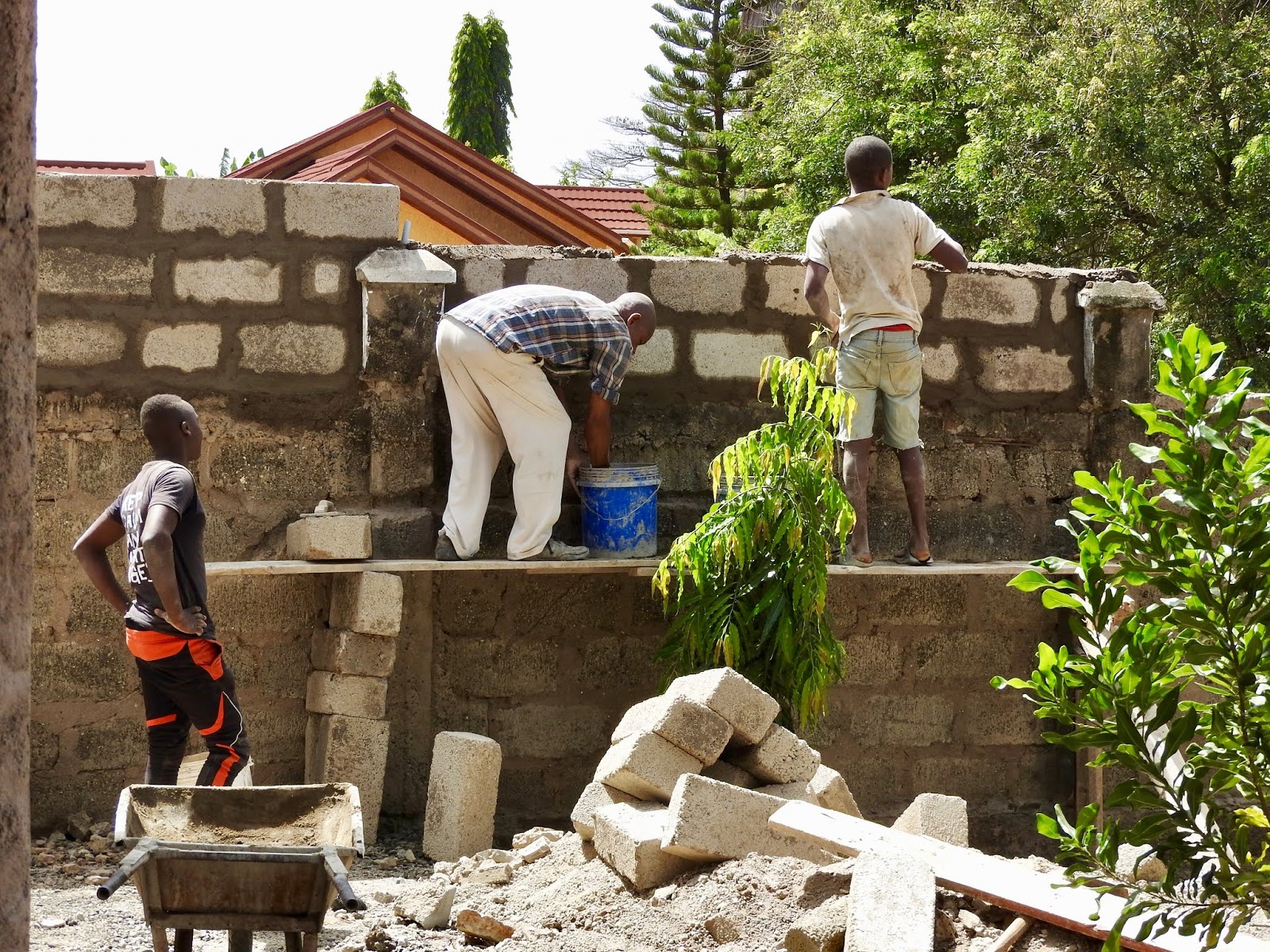
Hard at work on the wall.
The dada house at the very back of the lot.

There were three workers on site building a wall. It looked like very dirty, hard work, and progress seemed painfully slow. However, with the cement blocks weighing about 35 lbs. each, it would have been difficult to lay them quickly.

I noticed some spectacular rocks in a pile of ordinary rocks and got super excited. Geoffrey said they were rocks that he and Maso had bought in order to find rubies. I knew that the Masai mine rubies, but I had never seen the minerals in which the rubies are embedded before.
I was super excited and gathered several specimen which had traces of ruby formations. Maso told us later that he and his brother had bought a couple truck loads of big rocks from the ruby mining site near Longido and then broke them apart looking for rubies they could sell. With the first truck load, they did very well, but with the second truck load, they just broke even and decided they had had enough rock cracking. I didn’t care about finding any rubies; I just wanted some of the leftover rock pieces.
The surprise rocks.
I was very excited.
There were many smaller specimen, too.

After we finished our time at Mama’s construction site, we drove further out to the family’s shamba, a three-acre plot of land on which they usually grow corn and other crops for themselves. Many people have shambas back in their villages and the crops grown there help city people supplement their food supplies, especially corn. This year, however, nothing had been planted on the Kundayo shamba because the family is now planning a different use for the land. The city of Arusha keeps spreading out, and a new ring road is being built to the south of the city. The Kundayo’s shamba is very close to this new road and is thus now a hot property for development. So, their plan is to build a house for Maso and then a number of smaller rental houses on their land. The view of the hills around Arusha is definitely a plus at this location, too.

After our stop at the shamba, Geoffrey drove us onto a completed section of the new road which connects with the Njiro Road and we headed back home—sort of. Just after we passed the Njiro Complex. he turned left onto an insignificant dirt road and back beyond the stores on the main road to a small cafe owned by his wife. It was impeccably neat and clean, and we got to meet Mama Sidney and the two younger sons. We had soft drinks—Mary Lou’s first Stoney—and then drove out again to Njiro Road, but not home yet.

Relaxing at Mama Sidney's cafe.

Just a little further away on the main road, we stopped to see two shops the Kundayo family owns and leases out. The one shop is a bridal rental shop, which specializes in white frilly wedding dresses, and the other shop was being repainted and prepared to become a dress shop. We had an interesting visit with the manager of the bridal shop, who certainly seems to know her business, but I really wonder if there is enough business for her to make it financially. Tanzanians are very entrepreneurial, but many small businesses come and go very quickly.
Let's hope Judy succeeds.

Finally, we did return to Kundayo, ending a truly interesting tour of more of the Kundayo business empire. They are a great example of what an enterprising family can accomplish when they all work together.

John had decided that we should have kuku na chipsies (chicken and french fries) for dinner, which pleased me greatly. We also steamed some broccoli so as to have something green with our meal.