Monday, March 26, 2018

Farewell to ACC

Arusha, March 18, 2018, Sunday

It was the best of days; it was the most difficult of days. ACC had asked me to give the sermon for this morning, and though I had carefully prepared, I was still quite anxious about how things would go. Not only would what I was going to say be acceptable but also if I’d fall flat on my face as I climbed up the steps to the pulpit platform. I didn’t want to rely on John to help me up, so I was on my own. Fortunately, all went well. I didn’t stumble and fall; I didn’t have any blank moments; and I stayed within the time frame of 15-20 minutes. What surprised me was that the congregation clapped at the end. I’d not seen that happen before, and my first thought was that they were as relieved as I that I have managed to get through it without a major flub. The two comments I liked best were one from a Catholic sister who said, “Now, that was a real homily.” (I’ll have to find out more of what a homily means to Catholics.) The other best comment came from Africans who told me that they could understand everything I said because I enunciate clearly and speak at a moderate speed. As, I told a friend, that’s the pay-off from all of the years I spent teaching international students.

Yellow roses are my favorite.

After church people dispersed more quickly than usual because of rain. It wasn’t really raining, just spitzing, but it looked as if it would pour any minute. Deborah and Joe Troester asked if we wanted to go to lunch with them, and of course we did. So, they drove us our to the Njiro Mall to eat at Whispers, the best Chinese restaurant in Arusha. Being with the Troesters was bitter sweet, as they are being reassigned to Zambia and will not be here when we return next year. They will be greatly missed by many, and Deborah will leave a big hole in our women’s group.

Once we were back at Kundayo, we took time to rest for a bit and then got to some serious packing. I’m always surprised at how long it takes me to pack so relatively few things. It’s also odd that since we use up or give away so many items we pack from home, we still have almost too much to fit back into our suitcases. I do buy some gift items, but not so many anymore. Everyone I know is now pretty well supplied with kitenge placemats and napkins, beaded coasters, and small tinga-tinga paintings.

Now, our big task is to eat all the perishable and leftover food we still have. I made spaghetti bolognese for dinner, and we worked on eating our frozen raspberries. Not such a bad combination. That leaves us with some leftover coconut beef stew and two Russian sausages, which is more than enough since we’ll order from the restaurant here for dinner tomorrow when our friends Eric and Bernice Rowberg come.

Sunday, March 18, 2018

Masai and Mutton Stew

Arusha, March 17, 2018, Saturday

On this day, forty-five years ago, we brought home our daughter, Rebecca Suzanne. She was just over three months old and very tiny for that age. She had intensely blue eyes and watched us very carefully at first. Then, she settled in and became a little princess, the first granddaughter on both sides of our family. How quickly the years have passed since then. Now, she has her own daughter, our first grandchild. But, I’ll never forget a minute of that “homecoming day,” when I got all dressed up in a new dress someone had sewn for me, and John and I, and my mother, who had come from Indiana for the occasion, went to The Cradle in Evanston, Illinois. We walked in as a couple, and walked out as parents. It was an amazing day.

And, here all these years later we are in Arusha, Tanzania, finishing up our annual stay from January into March. In only three more days we’ll fly back to Spokane, and I feel so unready for the return to life in the U.S. We’ve begun some sorting and packing, but a lot of that will have to wait until much nearer our departure. We’ll leave a large box with clothing and kitchen items we which we use only here with Mazo, as we did last year. That cuts out an extra suitcase for us when we fly.  And, I’ve begun to give away items,especially books, that I don’t need anymore. This should allow room for packing home the few souvenirs and gifts I have bought, plus 2 kg, of coffee beans from Kitamu.

In the morning, the director of Nariva Academy, the school which Goodluck attends, came by to meet and visit with us. Ray had wanted him to meet with us because getting out to visit Goodluck’s school would be very difficult for us. We would have to drive through Arusha National Park and pay an entry fee of $30 each and a vehicle fee of $20. To drive around the park would more than double the distance, most of which would be on very bad road. So, the director, Lepilal Lairser, came to tell us about the school and comment on Goodluck’s progress. I was very pleased with both reports. The school is only elementary up to the 7th year, and relatively new, yet its students score very high on their exams. As a boarding school, the faculty can control and supervise study time and homework in a way that cannot be done at the day schools here in Arusha. This seems to be a good environment for Goodluck, whom I have always though of as being more Good Time than studious. However, according to Mr. Lairser, Goodluck is doing well in his classes, especially science and math.

When I asked Mr. Lairser about his own educational background, he told us a remarkable story of growing up as a traditional Masai child whose father saw education as useless and would not allow him to attend school. So, he appealed to the elders, who told the father to let Lepilal attend school and see if he was any good. Well, he was very good and scored high enough on exams to earn a scholarship. The father was not ready to lose a cattle harder, so again Lepilal appealed to the elders, who again backed him. This continued year after year until he was ready to enter college. By that time he had left his father’s boma and was living with an uncle, but the elders told his father that he had to sell some cattle to pay for college. Eventually, Lepilal graduated, got a teaching job at a very good private school here in Arusha, and was able to give his father very impressive gifts. When the father saw the reward of all the years of education, he declared that Lepilal was his only real son. This parallels my friend Elizabeth’s story in so many ways. Only very recently have Masai parents begun to see the value of an education, and there are still many children who do not get to attend any school at all. The fathers need them home to herd the goats and cattle.
Ray and I with Mr. Lairser

After Mr. Lairser and Ray left, we began to assemble some lunch. Naturally, we are doing our best to use up any produce or groceries we have on hand. I had everything figured out so that even the leftovers would come out just right at dinner on Monday.  So, just as John was heating up leftover eggplant stew and rice, there was a knock on our door. There stood Emanuel, on of the staff, with two large lidded casseroles that Mama had sent us. When John opened the one casserole an incredibly delicious aroma came out. It was lamb stew, and in the other casserole were potatoes. We each took a taste of the stew and then set the food aside to use for dinner. Then, there was another knock. It was Sidney delivering a bottle of wine from Mama, too.

In the afternoon, it rained and rained and rained some more. This is the wettest March I have ever seen here, and I hope it is a very rare anomaly. I spent most of my time going over the talk I was preparing for church on Sunday. Eventually, John heated up Mama’s lamb stew, and we ate dinner out on the terrace even though the world was wet and cool. The stew was amazing!  The absolute best I have ever eaten. So delicious that both John and I talked about licking the serving dish after we had eaten absolutely every bite. That Mama is a treasure.

This and That

Arusha, March 15 -16, 2018, Thursday and Friday

With so many end-of-stay activities and rain deluges, it has been difficult for me to find much time to sit and think or write. Yesterday, Thursday, the rain was horrendous until late afternoon, and then it fell again during the night. I’ve given up trying to keep track of when we have electricity or not. It’s really not very important because when the power goes out, our light switch automatically to solar power, and we have two gas burners to use on our kitchen stove. It’s hard to feel at all inconvenienced here at Kundayo.

Even though it was raining buckets all morning yesterday, we met up with our friend Terry Morton at Kituma yesterday for lunch. She’s going back to the States for 2 months for fund raising and leaves on Monday.  She does some wonderful work with albinos in Tanzania, and we wish her well. However, everyone who has an NGO, be it a seed program, health clinic, school, or orphanage, does the same thing. Many of the people I have met these past weeks at Kudayo come to Tanzania for several months and then return to their countries, e.g. Holland, Italy, Sweden, the US, to raise funds before returning for another period of time here. There are so many competing hands stretched out for donations that I find it overwhelming at times.  My little effort to change the world has focused mainly on providing quality education for a few children and making donations to a very small group of organizations.

Before we met Terry at my new favorite place, Kitamu, John and I had Ray drive us quickly to a few places where one of us could jump out of the car, dash through the rain, and get what we needed. John ran into Moona’s to buy an ACE bandage for my ankle, which has made some crackling noises and hurts more than it did. Then, it was my turn to splash into  Gohil’s, the place for spices in Arusha, to make some gift purchases there. John also went to Meat King for our very last bit of beef before we leave next week. We still got to Kitamu before it was time for Terry to arrive, so we ordered juices. John had mango juice, and I ordered a mixture of avocado, beets, and mango juice. It looks like a blood transfusion and seems very popular. So, I wanted to try it, and now I’m pretty sure once will be enough.

By the time we had finished lunch, the rain had let up. Since Terry had come in a taxi because of the deluge, we had Ray detour a bit to take her to her house on our return to Kundayo. She lives in a tidy little triplex back off the road to Njiro. It’s larger than our apartment at Kundayo and has a second bedroom, but it is not more luxurious. I’d much rather live here with other people around all day long, than behind a big wall and gate in relative isolation. However, because Terry’s co-worker, Sister Martha, who herself in an albino, lives in one of the other apartments, Terry chose to live there, too.

The rest of the day passed as usual, with more rain during the night.

Friday morning found me busy trying to finish up the last draft of the talk I am to give at church on Sunday. Originally, I had declined to do this, but then there was some sort of crisis with the other person who had been scheduled, and I agreed to step in. It didn’t take me long to compose what I want to say, but I keep editing and adjusting the text. This likely will continue right up until we leave for church.

Just before noon, I made may annual pilgrimage to my Arusha coiffeur, Aly, who is one of the most fey persons I know. His mother came from Vancouver, B.C. for a 5 month visit, and he was buzzing with news about that.  This was the first time in almost 7 years that they had seen each other. Ali reported that his mother spent a lot of her time at the mosque and did not bother him at all about all of his partying and drinking. He is looking more battered and pickled than ever. Also, he now has 5 ( or is it 6?) dogs instead of just two. The newest dog is a sweet Shepard puppy named Simba.

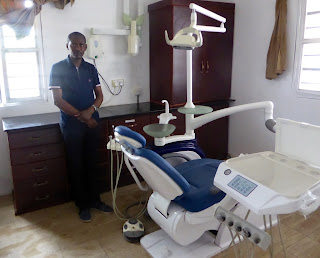
John went his own way to meet up with a young dentist who attends ACC and is now working on setting his own clinic.  Dr. Eric Mbele was proud to show John the renovated house which will house his practice and some of the equipment he has purchased.  He has big plans, which will likely work out, since by his estimate, there are only 7 dentists in Arusha with a population of about half a million who have the training and equipment necessary for modern dental care.

Dr. Eric Mbele's new dental clinic under remodeling

Dr.Mbele's new equipment

Later in the day, Mama was sitting outside, so I decided to use a chocolate chip cookie mix I had and bake a treat for her. She was very appreciative, but told me that American cookies are too sweet—have to much sugar. She ate two and shared the others with the nearby staff and workers. We chatted for a while before a neighbor showed up to visit and I could return back to our place.

I wanted to use the beef John had bought yesterday in a coconut beef stew but couldn’t find a recipe in which only the spices I had were used. So, I pieced together my own recipe, and it turned out very well. (I just hope I can remember what I did—and didn’t do.) While I was in the kitchen, we could hear really beautiful music—hymns sung in a distinctive African style and harmony. This continued for a long time, followed by a loud session of fervent prayer, and then another shorter time of singing.  Later Mazo told us that it was Mama’s church support group, meeting in the lodge’s lounge. I should have known the group was Lutheran by the excellent music.

By 9:00 there was thunder, lightning, and pouring rain again. The electricity went off and stayed off all night. The rain finally stopped before dawn. The only good thing about this weather for us non-farmers is cooler temperatures. We stay in the mid- to high 70s by day and go down to the lower 70s at night. It’s perfect for sleeping.

Wednesday, March 14, 2018

Deluge!

Arusha, March 13, 2018, Tuesday

This has been without a doubt the wettest day I have ever experienced in Tanzania. The temperature got down to 69ยบ before we went to bed and the sky was very dark and gray when I awoke this morning. Within minutes torrential rain began falling. This continued until after noon. I felt as if we would be trapped in our apartment for the day, as we couldn’t have even made it to the garden terrace without getting soaked—and we have umbrellas.  However, around 1:00 p.m. the force of the rainfall diminished, and we called a taxi and took off to town for lunch.

Ray wasn’t here for us to call. Yesterday morning he came to tell us that his mother-in-law was in the hospital in Moshi, so he and his wife needed to go there right away. I certainly hope this is not a serious situation, as Ray has already had too many sad deaths in his extended family so far this year.

We asked our substitute taxi man, John, to take us to Bamboo by Fifi’s, which is a popular cafe with a good wifi connection and upscale food. The prices are a little higher than at some other places, but there are also some bargains, e.g., its huge fruit salad, to be had as well. When the waitress saw that I was hesitating about what to order, she pulled out a much smaller menu with only African dishes all at very good prices. I had no idea that existed and had wondered how Tanzanians could afford to eat there. I was able to get a great plate of rice and maharagwe (red beans) for only 3000 Tsh. (Less than $1.50) and the wonderful Fifi’s fruit salad for 6000 Tsh. This was more than I could eat without John’s help on the salad, and all for only about $4. I’ll never eat there again without asking for the Swahili menu!

Then, while John went to a bank to get us some more T schillings, I sat and read while having a great cup of coffee. The waitress was fascinated by my Kindle, so I showed her the “library” of my books, how to change pages, and how to increase or decrease the text size. She thought being able to download books from the internet sounded wonderful, so I had to tell her they cost money from a credit card. That didn’t sound so good to her, and when she asked the price, and when I said the lowest price was $49, she was really sad. There ought to be some way of getting electronic books to people in African countries at a low price they could realistically afford. Otherwise, the education and information gap between western and nonwestern countries will just continue to grow larger.

I forgot to say that when Taxi John dropped us off at Fifi’s, we decided to go first to the nearby bookstore. (It used to be the Lutheran Bookstore, but now it has new owners.) We wanted to buy some books to leave for the Mtui children. I knew I wanted a very good English dictionary for Priskilla, and found a great one from Oxford Press for her. Then, I noticed an attractive hardbound book of bible stories for children in which a child could color in the accompanying pictures. It was in Swahili, too, so I bought it for Anita.

Good Luck proved to be a much harder case. Finally, John chose two small books in English for him, one a story and one about animals with backbones. As we turned to walk to Fifi’s, an older street vendor I’ve often seen came by with soccer jerseys, and I asked if he had anything from Manchester United, Good Luck’s favorite team. He didn’t but said while we were in Fifi’s he would see what he could find on the street. In less than an hour, he was back with both a shirt and pair of shorts in Good Luck’s general size, and though the whole outfit cost more than I had wanted, we eventually agreed on a price I could swallow and he was happy about. I have little doubt that Good Luck will be ecstatic.

It was after 3:00 by the time we returned to Kundayo. The rain had almost stopped. However, everything was still wet and dripping, so not many folks were out and about either here or out on the street. John rested for a while and then walked down toward Philip’s Corner to a print shop to get a document printed out and to place an order for printing some photos as well. I stayed in and began preparing a kettle of Congo Eggplant Stew for our dinner this evening. Of course, the electricity went off for a while. It soon came back on though, and the rest of the evening was peaceful and uneventful.

John at his terrace office

Produce for the day

Tuesday, March 13, 2018

Sunday Friends and Showers

Arusha, March 10, 2018, Sunday

It was a quiet and very wet Saturday. The electricity went off and on over over and over, but usually was not off for more than several hours at a time. Sometimes the wifi went down as well, so we read and used word processing much of the time. John took his usual walk into town and bought bread and a few vegetables, but I stuck to Kundayo. Mama wasn’t out much because of the rain; we only had time to greet each other and then run—well, she doesn’t run—for cover.

Yesterday, Sunday, we had Ray pick us up as usual to take us to ACC. He himself had not been to church as he had been up until the early morning at a neighbor’s wake. Showing solidarity at a death is extremely important here. Mama even goes to pay respects to people she has never really liked. So, Ray, who never ever misses church or his men’s prayer group, gave up church to sit with the neighbors almost all night.

The service at ACC was better than average. The music was well chosen and the strings accompaniment was excellent. Linda was not present to play the piano as she usually does. Her daughter Sarah had had a bicycle accident in South Africa and broken her collarbone. The break was bad enough that Sarah needed surgery, so Linda flew down to be with her. I so hope she will be back before we leave. One of the women here whom I really, really like, Deborah Troester, gave the sermon. She and her husband, Joe, are being moved to Zambia soon, so I will not see her again when we return next year.
Joe and Deborah Troester with Atula

After the service, Tim Wright and his wife, neither of whom I had ever met before, came to talk with us. John had met them in Nairobi last week, and in one of those strange “small world” events discovered that they were the people who had followed us in 1975 at Kakinda in the Congo, where John did his doctoral research, and two-year-old Becca and I learned about survivalist living. Becca and I had flown home several months before John, and because of wanting to keep my luggage light, I had left behind several items for John to ship home later. Becca had worn a pair of little yellow rain boots, which I dearly loved. John promised to ship them home, but instead he left them for the Wrights, as they had several small children. All these years, I have mourned those boots, and now I met up with those who knew them last. It didn’t seem to me that the Wrights had loved those boots as much as I had, but at least I heard the rest of the story.

I also introduced John to Susan James, another person I find extraordinarily fascinating. She is from Minnesota, where her husband teaches wildlife conservation at the University of Minnesota. While he’s busy with that, Susan operates her own business which contracts with different agencies and NGOs to do surveys and data analysis for them. She has been doing this for 8 years now in Tanzania and uses very bright university graduates to do the data gathering, etc. In fact, she is the only mzungu involved in the work here. Once, when I had asked her if she has ever thought of doing a survey on gun ownership here, she looked taken aback and commented that wouldn’t tell much, as no ordinary citizen would own a gun unless they were a hunter and had an old rifle. Susan is also Linda’s “best friend,” just as Linda tells me I am.

We had spent so much time talking after church that we hadn’t found out if anyone was going anywhere for lunch. So, we found a taxi and took it to George’s, where others often show up. No no one we knew was there, so we took a table outside—the waiter assured us it would not rain. The sky kept looking more and more ominous, and just then the Mosley family—Paul, Rebecca, and their two boys showed up—so we asked if we could sit with them inside. Of course, they said yes, and we picked up our beverages and went under the big thatched roof. Just about then, it began to pour, harder than any other deluge so far. There was also a strong wind which whipped the rain in through the open sides of the pavilion, so we had to move again to the back away from the side in order to keep dry. Not only did the rain fall extremely hard, but it kept up for at least an hour. John kept wondering how long we might be trapped before we could get back to Kundayo. The din of the rain made it extremely difficult to carry on much of a conversation with Paul and Rebecca. However, we did have some moments of communication and found them to be very interesting and enjoyable people. They came this past summer to work with MCC, but because they have young children and normally do their own thing after church, we hadn’t gotten to know them before.

Of course, the rain did eventually die down and we called Ray to get us back to Kundayo. After that, we tried to take a nap, and eventually I made dinner (braised chicken, mashed potatoes, and sauced zucchini, with fruit for dessert). We tried to have a video chat with Peri, but the internet was not functioning well, so we only got a few seconds of actually seeing her and hearing her voice. I don’t know what she saw or heard. We’ll be home soon, and then we can talk face to face again. Oh happy day!

Monday, March 12, 2018

A Resort and a Ring

Arusha, March 9, 2018

We had decided that we would go and discover more about the big restaurant Ray had shown me on Tuesday. I found out that its name is Asili Resort, which seemed odd for a restaurant without any hotel attached to it. Anyway, we sat over on the terrace and worked on our computers or read until nearly 1:00 p.m.  Then Ray came to take us to the “resort.”

I asked Ray to drive us on Kanisha Road so we would pass by the Peace Restaurant, where I had braved the rain and mud to cross over a temporary wooden bridge to enter. Today it was dry, but I wanted John to see the dirt piles and deep trench.  He agreed with me that the trench was at least 8 feet deep. Even Ray got out of the taxi to have a look. Some sort of cable is being laid, but a workman told John that this is being done for a sewer line. The entire trench is being dug by hand, foot by foot, both deep and block by block.
Peace Restaurant, now dry

Bridge over deep trench

When we got to Asili and entered the restaurant, there were a few African diners scattered throughout the one side, and on the other side, there was a large group of wazungu tourists—maybe European, not American. There was a buffet lunch laid out for the group, and our waitress invited us to have that, too, if we wanted. John thought that sounded pretty good, so we went over to serve ourselves. It was a buffet of all African food: banana soup, rice pilau, chicken stew, beef stew, vegetable stew, ugali, greens, Swahili salad, three types of baked yams/sweet potatoes, beef mishikaki, and fruit. There was plenty to eat, but we were disappointed in the quality. Nothing was seasoned well: the pilau was over loaded with cinnamon, and the stews were bland. There was no wali (plain rice) or mandazi. We questioned our waitress again about whether there were rooms for rent, and she said, “No, we are a resort, so we only serve food and beverages.” A rather strange definition for the word resort.
On the exterior wall
The impressive entrance

The waitress also told us that while they serve the public, they specialize in large safari groups like the one there with us. Asili certainly has the space for that since it is every bit as expansive as the dining areas in the big lodges we’ve visited in game parks. I would advise, however, that their chefs take some cooking lessons or hire some mamas to improve their food. The regular menu offers mbuzi (goat) and chipsie in its African section, so why didn’t they offer that to the tourists?

 One half of the large dining area 

We couldn’t find a taxi after lunch, so we walked back to the main street, Moshi Road, to see if we could find one there. To get to the larger road, we had to pass the curio shop where I usually buy gifts each year. Of course, all the workers just happened to be outside. They greeted me and asked why I hadn’t come in yet this year. I gave a vague response and kept walking. When we got to the main road there was a big police stop right at our corner.  Of course, absolutely no taxis were approaching from either direction. Taxi drivers warn each other about police stops so they can avoid being hassled and having to pay a bribe or worse yet a fine. We wanted to go to the House of Gems to pick up my ring, which had been sized for me, but it was too far away for me to walk.  We had no choice but to wait patiently until finally a taxi approached. While waiting, I was pestered by a street vendor named Johnny. He was absolutely certain that I had to buy some of his bracelets. I finally convinced him that I really didn’t.

We  were rescued by a taxi driver who took us to the House of Gems and waited for us while I got my ring and looked at other rings and pendants in the $100 and under range. There were some nice items which would make good souvenirs for students on limited budgets who still would like a bit of Tanzanite. With my ring on my finger, we continued back to Kundayo, where Mama was outside waiting. I gave her a short report of our lunch, and she examined my ring. She, of course, would have gotten a far better stone and setting.  However, I like my simple circle and twinkling bit of blue. Rain cut our conversation short, but I’m sure we’ll resume the topic.
Slightly better stones than mine

My ring

The rest of the day provided time for washing underwear, reading, and watching some TV when the power was on. For dinner, we had the fish fingers John had purloined from the women’s lunch on Thursday. It’s the first time I’ve ever eaten fish fingers wrapped in a mayonnaise smeared chapati. It was actually a fairly good wrap, But I think I can improve it if I try it again in the future.

Saturday, March 10, 2018

Women's Group at Kundayo


Arusha, March 8, 2018, Thursday

It wasn’t raining when I awoke this morning, and the electricity was on. Both were good omens for a day when I was hosting my women’s group here at Kundayo.  Mazo and I had worked out a menu: vegetable curry with rice, fish fingers (not at all like our fish sticks), samosas, Swahili salad (thinly sliced tomatoes, red peppers, and cucumbers in a vinaigrette), fruit salad, and mandazi.  Of course, there was also tea and coffee. Ray also showed up with a stack of chapatis his aunt had made for me.

Our stated meeting time is 9:30, but the only woman here by then was Terry. Since she is American, she still believes in promptness. Others vehicles began to arrive just before 10:00, and soon after we began our meeting. Mama Bishop, a retired Anglican bishop’s wife who is usually fairly dour, entered with her fist in the air and wished us “Happy International Women’s Day.” (She recently had a mild stroke, so who knows what transformation that has brought her.)  Then Linda had to share all the emails she had gotten from former members now living elsewhere but who still feel connected to the group. It’s amazing how many women still link back to the sisterhood here. Eventually, Linda decided we had to get to the lesson, which had so many funny things in it that Deborah and I kept muttering in spite of Linda’s cautionary glances. I mean, who would’t laugh at that the part in Numbers 11 where God says he’s going to send the whining Israelites so many quail the meat will run out of their nostrils?
Always a two-cheek greeting

The buffet

While we were contemplating the idea of dead quail 3 feet high on the ground out in the Sinai Desert, the sky here grew dark, and I became worried about rain. Mazo and Beatrice were busy out in the garden area, setting up tables with cloths for our lunch buffet. I had told Mazo to have everything set up by 11:45, but Linda took her time and the women had a lot of news to share, so it was about 12:15 before we exited the lounge, where we had been meeting. The buffet table looked perfect; the sky was clear and blue; and the women were very pleased with the menu. The oldest women, Mama Bishop and Mary Bura, commented on how excellent the chapatis were. They really were the best I have ever had.
Enjoying our lunch

The women wanted John to join us, so he, too, had a great lunch. Several women lamented the decrease in our number. This week, Margaret was in Uganda; Miriam was at the hospital with her husband; Eunie was just out of the hospital; and Atula didn’t come.  However, more serious is our continuing loss of members who leave Tanzania or transfer elsewhere. This week, Christine from Switzerland, moved to Nairobi, where her husband has a new teaching position. John took photos of us as a group, and we’re a much smaller group than just two years ago, when I had a group photo taken at Linda’s house. We need to find some way to recruit new members.
Our small group for the day

Once everyone had left, I collapsed on our bed and decided I had done more than enough for one day.  However, later I saw Mama Kundayo outside and realized she was hoping for a report of the day. So, I went out to sit with her and show her the photos I had taken at the school yesterday and with the women in the morning. She sent Sidney out to the corner to buy two ears of roasted corn for us. We sat there gnawing on our corn and discussing the photos until it was dark. Meanwhile, John had walked over to our neighborhood kuku na chipsies place to get something for our dinner. I didn’t have to make a single meal all day, and yet I felt as if I had put in a full day of labor. Social obligations both delight and exhaust me.
Reviewing the day with Mama. Beatrice sometimes helps translate.